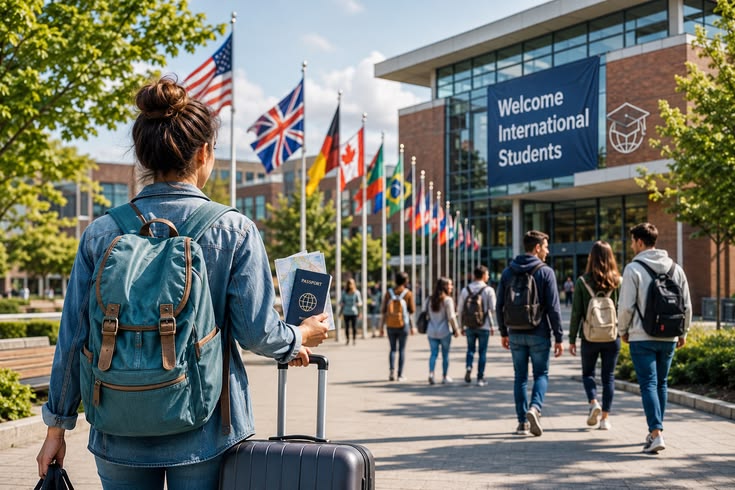
A few days ago, I came across a Reddit discussion asking a simple but thought-provoking question: Is studying abroad still worth it in 2026?
as expected, the comments were divided.
Some people said the experience is only enjoyable if you’re rich. Others pointed to the ever-increasing tuition fees, the rising cost of living, expensive accommodation, visa costs, and inflation as evidence that studying abroad has become a privilege reserved for those with deep pockets. Reading through the discussion, I could understand where many of them were coming from. The financial reality of studying abroad has become more challenging than ever.
But as I kept scrolling, I found myself lost in thought, and I came to the conclusion that I do not fully agree with what is being said.
As someone currently studying abroad, I believe the answer isn’t as black and white as people make it seem.
So, is studying abroad really worth it in 2026?
My answer is simple: it depends.
It depends on why you’re doing it, how well you’ve prepared, what opportunities are available to you, and whether you’re willing to adapt to a completely different environment. Two students can attend the same university, live in the same city, and have entirely different experiences because they approach the journey differently.
One point I particularly disagree with is the idea that you have to be rich to study abroad.
I certainly wasn’t.
I come from a middle-class family, and my opportunity to study in Indonesia came through a scholarship. Without it, studying overseas would probably have remained a dream for much longer. That scholarship opened the door, but it didn’t magically eliminate every challenge that came with living in another country.
Let’s be realistic—studying abroad does require money. Scholarships don’t always cover every expense, and even when they do, countless day-to-day costs quickly add up. Food, transportation, personal expenses, emergencies, social activities, travel, and those unexpected moments when life simply happens all require financial planning.
So yes, funding matters.

But there’s a significant difference between needing financial support and needing to be wealthy.
I’ve met international students from all kinds of backgrounds. Some are fully funded through scholarships. Others rely on family support, savings, grants, or educational loans. Their financial situations may differ, but many of them share something much more important: they’re determined to make the opportunity count.
Studying abroad isn’t a competition of who has the biggest bank account. It’s about making the most of the resources you have.
Interestingly, I’ve also met students who come from very comfortable financial backgrounds but still struggle with life abroad. That experience taught me something I hadn’t really considered before.
Money can make life more comfortable, but it doesn’t automatically make studying abroad easier.
It can’t teach you how to navigate a new culture.
It can’t teach you how to communicate with people who see the world differently.
It can’t teach you resilience when things don’t go according to plan.
And it certainly can’t build friendships for you.
Those are things you develop through experience.
Studying abroad constantly asks you to step outside your comfort zone. You’re surrounded by unfamiliar customs, different ways of thinking, new foods, different teaching styles, and people whose lives have been shaped by experiences completely different from your own.
Sometimes it’s exciting.
Sometimes it’s overwhelming.
Sometimes it’s both on the same day.
I’ve experienced language barriers that led to funny misunderstandings. I’ve had moments where I realized the formal Bahasa Indonesia I had learned wasn’t exactly how people spoke in everyday conversations. I’ve met people from countries I had only ever read about, shared meals with classmates from different cultures, and learned traditions I never knew existed.
Those experiences have taught me lessons that no lecture ever could.
One of the biggest gifts of studying abroad is perspective.
When you grow up in one country, it’s easy to assume that your way of doing things is the normal way. Living abroad quietly challenges that assumption. You begin to understand that there are many different ways to solve problems, celebrate achievements, communicate, build relationships, and see the world.
That doesn’t mean every experience is positive.
There are difficult days.
There are moments of homesickness, cultural misunderstandings, academic pressure, loneliness, and financial stress. There are days when you miss your family, your favourite foods, or simply being somewhere familiar where you don’t have to think twice before speaking.
Those moments are real, and they shouldn’t be ignored.
But I’ve also found that those same moments often become the ones that shape you the most.
They teach independence.
They teach patience.
They teach empathy.
They teach confidence.
Little by little, you become someone who can adapt to unfamiliar situations without immediately feeling defeated. You become more comfortable with uncertainty, more appreciative of different cultures, and more confident in your own abilities.
Looking back, I realize I didn’t just move abroad to earn a degree.
I came here thinking I was investing in my education.
What I didn’t realize was that I was also investing in my personal growth.
The classroom has taught me a great deal, but so has every bus ride, every conversation, every cultural celebration, every challenge, and every friendship I’ve built along the way.
So, is studying abroad worth it in 2026?
For me, yes.
Not because it’s glamorous.
Not because it’s easy.
And certainly not because it’s only for the rich.

It’s worth it because it stretches you in ways that are difficult to explain until you’ve experienced them yourself. It teaches you to think differently, live differently, and appreciate both your own culture and the cultures of others.
Would I recommend it to everyone?
Not automatically.
I would first encourage anyone considering studying abroad to ask themselves an important question: Why do you want to do it?
If your answer is simply because it looks exciting on social media, then the reality may disappoint you. But if you’re genuinely seeking an education, personal growth, cultural exchange, and the opportunity to challenge yourself, then studying abroad can become one of the most rewarding experiences of your life.
At the end of the day, studying abroad isn’t just about crossing borders.
It’s about expanding your perspective.
Yes, money helps. Planning matters. Scholarships make a huge difference. Having a support system is important. None of those things should be ignored.
But I don’t believe studying abroad belongs exclusively to the rich.
I believe it belongs to those who prepare, persevere, stay curious, and remain open to learning—not only from textbooks, but from the world itself.
That, to me, is what makes studying abroad truly worth it.
What do you think? If you’ve studied abroad—or are thinking about it—I’d love to hear your perspective. Has the experience been what you expected, or has it surprised you in ways you never imagined?